Clinical traceability in figures: what the evidence says
Almost everything published about clinical inventory traceability comes from those who sell the technology. This guide gathers only figures from peer-reviewed studies and independent evaluations, with the source for each one and what that source does not allow you to conclude.
Most of the loss is expiry, not theft
A tertiary hospital in Riyadh measured its inventory waste over seven years, between 2015 and 2021, against cumulative spend of SAR 7,396 million. After applying a zero-waste strategy, cumulative waste came to 0.21% of the total, equivalent to SAR 15.5 million. Before those interventions it was 0.91% of expenditure.
The most useful figure is not the magnitude but the composition. Of the value lost, 79.8% was expired product, 14.3% non-moving inventory and only 5.9% obsolete stock.
In other words: four of every five units of currency a hospital loses in inventory are lost because something expired in the storeroom unnoticed. That is not a security problem or a purchasing problem, it is a problem of visibility over dates.
Surgical inventory concentrates the risk
A literature review published in Health Systems in 2018 compiles measurements from different hospitals. Three figures from that review frame the problem.
- More than half of a hospital's inventory assets are surgical supplies and instruments (Ryan et al., 2014)
- Supplies opened and left unused during a procedure average USD 653, ranging from USD 89 to USD 3,640, and account for 13.1% of total surgical supply cost (Zygourakis et al., 2016)
- In a single neurosurgery department, that waste amounted to roughly USD 2.9 million per year (Zygourakis et al., 2016)
The three measurements come from different studies cited in the same review; they are not figures from one hospital and are not comparable with each other.
What changed when an RFID cabinet was installed
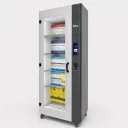
The most direct study on this category of equipment was published in Journal of Medical Systems in 2019. It evaluated an RFID cabinet installed at University Hospital Cruces in Barakaldo, Spain, a 981-bed referral centre, over six months.
250 units were tagged: 72 surgical materials and 178 implantables, with stock value estimated at EUR 369,211. Across the six months there were no stockouts and no inventory mismatches, and no incorrect assignment of product to patient was detected.
| Indicator | Before | After |
|---|---|---|
| Correct assignment of surgical product to patient | 36.1% | 100% |
| Correct assignment of prosthesis to patient | 86.1% | 100% |
| Inventory supervision time | 995 min/month | 428 min/month |
| Time spent requesting product | 400 min/month | 0 min/month |
| Time spent receiving product | 300 min/month | 133 min/month |
The total reduction in supervisory staff time was 58%. Product requesting was fully automated.
Getting the data off paper reduces stockouts
An evaluation of Tanzania's health logistics reform, published in 2016, measured what happened after an electronic logistics management information system was implemented in the medicines supply chain.
Stockouts fell from 32% to 23% across the average of all product groups, and stockouts lasting more than seven days fell from 24% to 15%.
The context differs from a Latin American hospital: these are medicines, at national system scale, in a low-income country. What does transfer is the mechanism measured, which is the same one: what happens to availability when the record stops depending on spreadsheets.
How to read these figures
None of the four studies is a randomised controlled trial. They are evaluations of real implementations, measured before and after, and that has consequences for what they allow you to conclude.
- An improvement measured before and after does not isolate the effect of the technology from the effect of having paid attention to the process
- The four studies were conducted in different countries, health systems and product categories, so their figures cannot be added or averaged
- None was carried out in Latin America, so the magnitudes should be taken as reference orders rather than projections
What is consistent across all four: losses concentrate in expired product and in product that was never recorded, and automatic recording reduces administrative time measurably.
Frequently asked questions
How much clinical inventory is lost to expiry?
In a tertiary hospital in Riyadh measured over seven years, 79.8% of the value lost to inventory waste was expired product, against 14.3% non-moving inventory and 5.9% obsolete stock. Total waste was 0.21% of cumulative spend after a zero-waste strategy was applied.
Does an RFID cabinet eliminate stockouts?
In the University Hospital Cruces study there were no stockouts and no mismatches across the six-month evaluation, over 250 tagged items. That is a result from one centre and one period, not a guarantee: it measures what happened there, not what will happen in any hospital.
How much administrative time does automatic traceability save?
In the same study, supervisory staff time fell from 995 to 428 minutes per month, a 58% reduction. Product requesting went from 400 minutes to zero because it was automated, and receiving fell from 300 to 133 minutes.
What share of a hospital's inventory is surgical?
More than half of a hospital's inventory assets are surgical supplies and instruments, according to Ryan et al. (2014), cited in a literature review published in Health Systems in 2018. It is the category where both the value and the risk of loss concentrate.
Is there peer-reviewed evidence on RFID cabinets in hospitals?
Yes. The study by León-Araujo and colleagues, published in Journal of Medical Systems in 2019, evaluated an RFID cabinet in a 981-bed hospital over six months and reports traceability, stockouts and staff time. It is the most direct academic reference on this category of equipment.
Do these figures apply to Latin American hospitals?
Not directly. The four studies were conducted in Spain, Saudi Arabia, the United States and Tanzania, with different health systems and cost structures. They serve as orders of magnitude and to understand what gets measured, not as projections of results for a hospital in the region.
Sources
- León-Araujo MC, Gómez-Inhiesto E, Acaiturri-Ayesta MT. Implementation and Evaluation of a RFID Smart Cabinet to Improve Traceability and the Efficient Consumption of High Cost Medical Supplies in a Large Hospital. Journal of Medical Systems, 43(6):178, 2019.
- Alanazi MQ, Alkhadhairi EK, Alrumi WH, Alajlan SA. Reducing Pharmaceutical and Non-Pharmaceutical Inventory Waste in Tertiary Hospital: Impact of ABC-VEN Analysis in a Zero-Waste Strategy Over 7 Years. Risk Management and Healthcare Policy, 17:2659-2675, 2024.
- Ahmadi E, Masel DT, Metcalf AY, Schuller K. Inventory management of surgical supplies and sterile instruments in hospitals: a literature review. Health Systems, 8(2):134-151, 2018. doi:10.1080/20476965.2018.1496875
- Mwencha M, Rosen J. Better Data Visibility and Data Use Result in Lower Cost and Improved Performance in Medicine Supply Chains. 2016.


Keep reading
Stockouts and expiry in clinical inventory
How stockouts and expiry arise, why adjusting safety stock does not fix them, which metrics to track and which mechanisms cut both costs.
RFID in hospitals: clinical traceability guide
What RFID is, how it differs from barcodes, which frequency each clinical application uses and how a traceability project is structured.